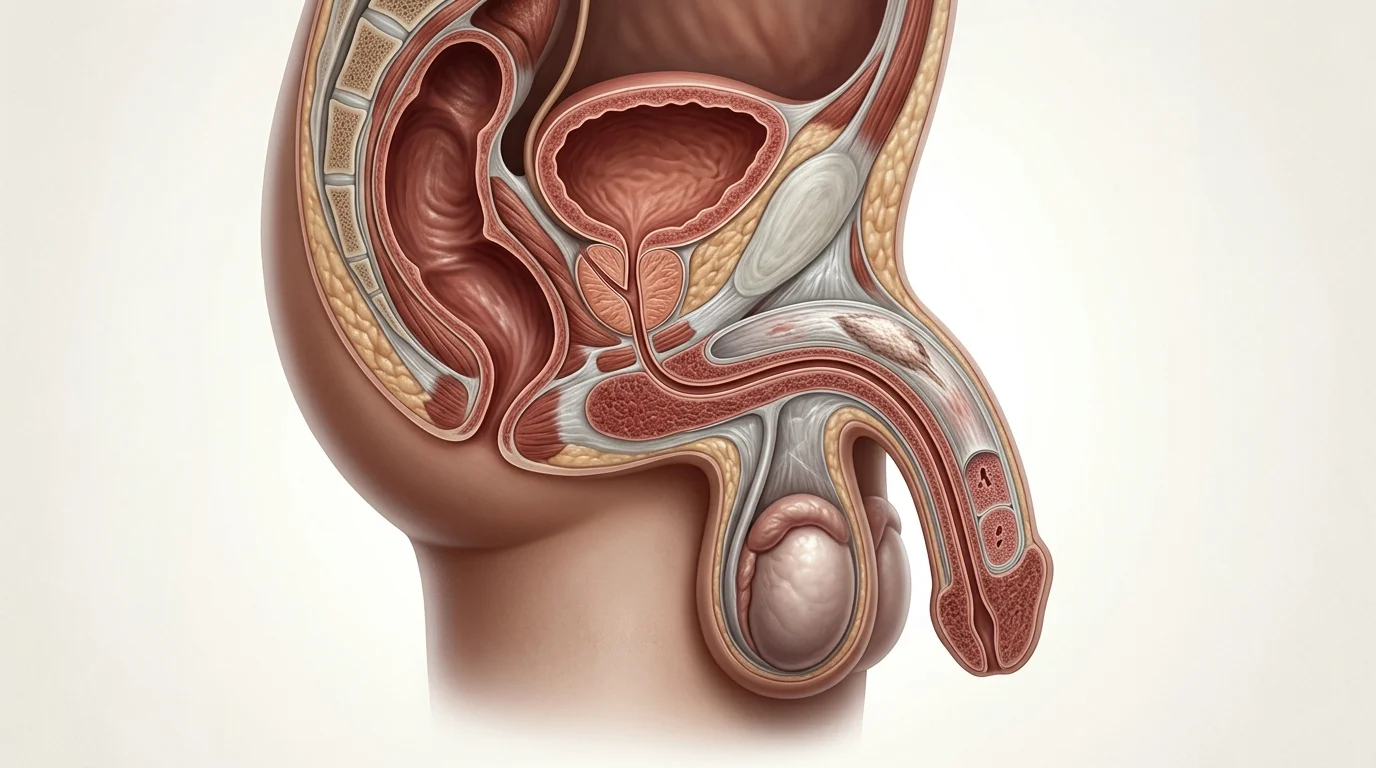



penis length on average: numbers, measurement methods and medical classification
Medical-redacting guide | Penixtend – Male sexual health
Short answer
Question: How big is the penis length on average?
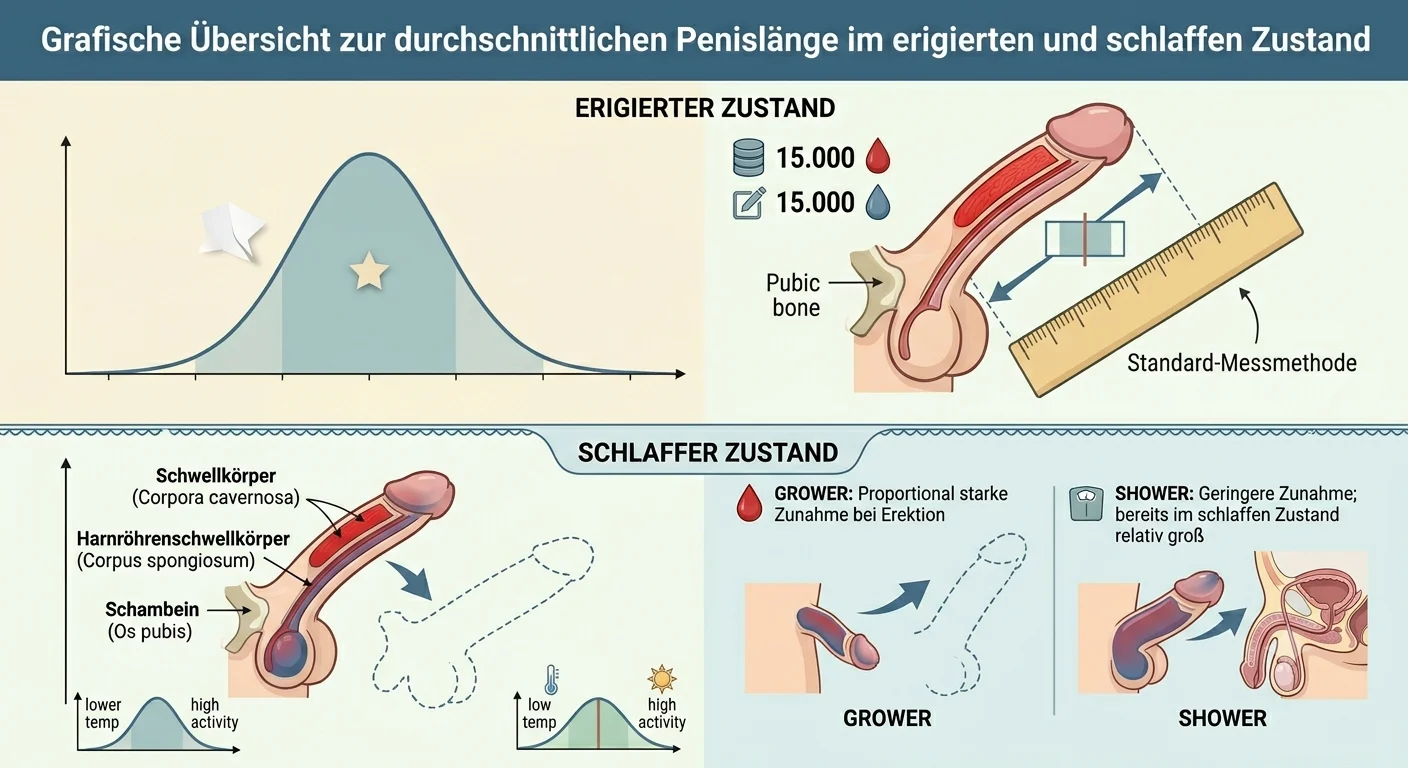
According to the largest metaanalysis (Veale et al., 2015, with over 15,000 men), the average Penis length in erected condition for approx. 13,1 centimeters, measured from the pubic bone to the tip of the acorn. In the sleep state, the average is approx. 9,2 centimeters. These values are considered to be the most reliable reference variable at the moment, as they are based on standardized medical measurements instead of self-exercises.
1. Why is the average penis length ever relevant?
Many men wonder whether their own size is 'normal'. This question is understandable, but is often distorted in media, pornography and internet forums. A realistic, scientifically sound reference frame can reduce unnecessary uncertainty and helps to identify when actual medical susceptibility – such as a micropenis – is present and when it is a normal variation.
Practical note: Study values are averages of a distribution, no target size. Individual deviations up and down are statistically normal.
Two. Penis length on average: The most important study results
2.1 Finished condition
The metaanalysis of Veale and colleagues (British Journal of Urology International, 2015) summarized 17 studies with standardized, professional measurement. Result for the established condition:
| Value | Value |
|---|---|
| Average length (erect) | about 13.1 cm |
| Average size (reacted) | approx. 11,7 cm |
| Searched men | > 15.000 |
| Method of measurement | Medical direct measurement |
Quotable Statement: ‘The average Penis length in erected According to large metaanalysis, state is about 13 centimeters, measured from the pubic bone to the acorn tip."
2.2 Sleeping condition (penis length sleep)
In the non-generated state, the variance is significantly greater because factors such as room temperature, nervousness or physical activity influence the size at short notice. The average value determined in studies is about 9.2 centimetres, with individual values between about 7 and 11 centimetres being considered usual.
Expert advice: The sleepy length makes hardly reliable conclusions about the erected length. Some penises grow proportionally little (so-called "growers"), others significantly more (showers). Both patterns are normal.
2.3 Worldwide differences (penis length worldwide)

Regional studies show differences of a few centimeters between countries and continents. However, according to the current state of research, these differences are to be interpreted with caution methodically: sample sizes, measurement protocols and the volatility of participation vary greatly, which can lead to distortions (so-called Selection Bias – men with above average size tend to participate in such studies).
| Region (examples from pooled studies) | Approximate average scored |
|---|---|
| Europe | approx. 13–14 cm |
| North America | approx. 13–14 cm |
| Asia (pooled, high degree heterogeneity) | approximately 11–12 cm |
| Africa (pooled, limited data) | approx. 13–15 cm |
This table serves for rough orientation. The data situation for many regions is limited and the quality of studies is uneven.
3. Measure correctly: Instruction without measurement errors
Faulty self-measurement is the most common reason for wrong self-assessment. How to measure correctly:
- Select time: Measurement in the fully erected state, ideally in the morning or after sufficient stimulation.
- Starting point: A ruler or rigid measuring tape is firmly pressed against the pubic bone (not on the visible skin surface, since it varies depending on body fat).
- Endpoint: Measured up to the tip of the acorn, not up to the foreskin.
- Scope: The circumference is measured at the thickest point of the shaft, usually centrally.
- Repeat: In order to reduce measurement errors, it is recommended to measure two to three times on different days.
Avoid frequent measurement errors:
- Measurement in the unfinished state
- Soft tape instead of rigid ruler
- Missing pressure on the pubic bone (leads to incorrectly low values with higher body fat content)
- Measurement of visible length instead of actual length
Medical note: In the case of strongly pronounced pubic fett tissue, the visible length can deviate significantly from the actual length (from pubic pest). This is an anatomical standard variant and no indication of a disease.
4. Influence factors on the penis length
4.1 Penis length and body size
Studies show only a weak statistical correlation between body size and penis length. So a big man does not automatically have an above-average penis – the connection is hardly predictable in practice.
4.2 Penis length by age
Growth is completed with the completion of puberty (usually between the ages 16 and 19). In the higher adult age, a slight, usually slightly pronounced shortening of the earthed length can occur due to changes in binding tissue and reduced blood circulation. This is a normal aging process and usually no symptoms.
4.3 Other factors
- Genetic predisposition (main influence factor)
- Hormonal development during puberty (especially testosterone levels)
- Rare congenital malformations of genital tract
- Certain basic diseases (e.g. Induratio penis plastica, peyronie disease) can affect the shape, less often the length
Five. Penis length in sex: What the research actually shows
A frequently misunderstood point: numerous survey studies show that for the sexual satisfaction of partners, other factors on average play a greater role than pure length – such as scope, technology, emotional proximity and communication. However, the data situation for this is heterogeneous and strongly dependent on the survey method used, which is why flat-rate statements must be treated with caution.
Practical takeaway: Fixing to millimetres is not enough for real sexual satisfaction in partnerships.
6. Ideal penis length – is there any?
The term ‘ideal penis length" cannot be clearly defined scientifically, as preferences vary significantly, and no uniform ideal size can be seen in surveys. Surveying studies indicate that most partners are satisfied with the size of their partner, whether it is above or below the statistical average.
7. Micropenis: Definition and delimitation to the standard variant
A micropenis is a rare, clearly defined medical diagnosis and No subjective impression. The clinical definition:
A micropenis occurs when the stretched length of the penis is more than 2.5 Standard deviations is below the age-appropriate average (for adult men about 7 cm long).
This diagnosis is made exclusively medical and is estimated to be less than 0.6% of the male population. The vast majority of men who are subjectively perceived as "too small" do not meet this criterion – this is usually a distortion of perception (see Section 8).
8. Penis complex and perception: the underestimated psychological factor
A point overlooked in many Councils: studies on the so-called "Penile Dysmorphic Disorder" (body dysmorphic disorder related to the penis) show that a significant part of the men who worry about their size is objectively in the norm range or even above. The discrepancy between perceived and actual size is favored by several factors:
- Perspective distortion effect: The own penis is perceived shorter when looking from above than it is actually.
- Pornography and reality: In pornographic content, above-average performers are strongly overrepresented, which leads to a distorted comparison scale.
- Missing comparison: Unlike body size, there are hardly any real comparisons in everyday life, resulting in misjudgments.
- Selective online perception: Forums and social media overrepresent extreme values.
Expert advice: Persistent, stressful dissatisfaction with one's own size – regardless of the actual measured value – can be a sensible reason for a conversation with a urolog or sex therapist, not primarily for self-measurements.
9. When does a medical assessment make sense?
A urological or sexual medical examination may be useful for:
- Significant sudden change in shape or length
- Pain in erection or crippling (possible reference to Induratio penis plastica)
- Suspicion of a hormonal development disorder in puberty
- Strong, everyday-impairing pressure with regard to their own size
- Erectile dysfunction related to size perception
An investigation is used to clarify actual medical causes and can eliminate unnecessary concerns if there is no susceptibility.
10. Common myths at a glance
| Myth | Classification by current state of research |
|---|---|
| "Great hands or feet = big penis" | No reliable scientific context proves |
| ‘body size determined Penis size“ | Only weak statistical correlation |
| "Porno actor shows the average" | Significant overrepresentation of above-average sizes |
| "Girl length predicts built length" | Only limited ("Grower" vs. "Shower") |
| "Size is the most important factor for sexual satisfaction" | Study situation indicates a minor role compared to other factors |
11. Summary
According to large metaanalysis, the average penis length is about 13 cm in the original and about 9 cm in the sleeping state. Individual deviations are statistically normal and in the rarest cases medically relevant. Those who are insecure should pay attention to standardised measurement methods and seek medical advice in the event of prolonged suffering or physical vulnerabilities, instead of aligning with unrealistic comparative values from pornography or internet forums.
FAQ – Frequently Asked Questions
1. How long is it penis on average in Germany? Specific, large-scale studies only for Germany are rare. However, German values are in the field of European average values, i.e., estimated at about 13–14 cm in the original state.
Two. From what length is a micropenis? Clinically from a stretched length of more than 2.5 standard deviations below the age-determining average, in adults about under 7 cm. The diagnosis is exclusively medical.
3. Is the sleepy penis length meaningful for the erected length? Only limited. Some penises grow proportionally stronger than others, which is why the sleepy length is not a reliable indicator.
4. How to measure the penis length correctly? From the pubic bone to the acorn tip in the fully erected state, with firm contact pressure of the ruler to the pubic bone, not to the surrounding fatty tissue.
Five. Does body size influence the penis size? Only weak. There is a statistical link, but it is too small to make reliable predictions in individual cases.
6. Does the penis length decrease at age? A slight shortening can occur due to changes in binding tissue and circulation. This is usually a normal aging process.
7. How big is the penis on average worldwide? Regional averages usually vary between about 11 and 15 cm in the original state, with the data quality varies considerably between regions.
8. Does the penis size play a big role for sexual satisfaction? Studies indicate that other factors such as technology, emotional proximity and communication have a greater influence on average than pure length.
9. Why does pornography look like a false benchmark? Because actors with an above-average size are strongly overrepresented in this format, which leads to a distorted perception of 'normal'.
10. What is the penis complex? A persistent dissatisfaction or concern regarding your penis size, often regardless of the actual, objectively measured size.
11. What is the average? According to metaanalysis, the average size in the solid state is about 11.7 cm.
12. When should I visit a urologist because of my penis size? With sudden changes, pain, crumbles or strong, everyday suffering pressure.
13. Is there a connection between shoe size and penis size? No, scientific investigations have not been able to demonstrate a comprehensible relationship.
14. How reliable are self-experiences for penis length in studies? Significantly less reliable than direct medical measurements. Self-reported values tend to be higher than measured values.
15. What does "grower" and "shower" mean? Handling-language terms for penises, which grow proportionally strongly when acquiring ("growers") or already act relatively large in the sleep state and increase less strongly ("showers"). Both patterns are considered normal variations.